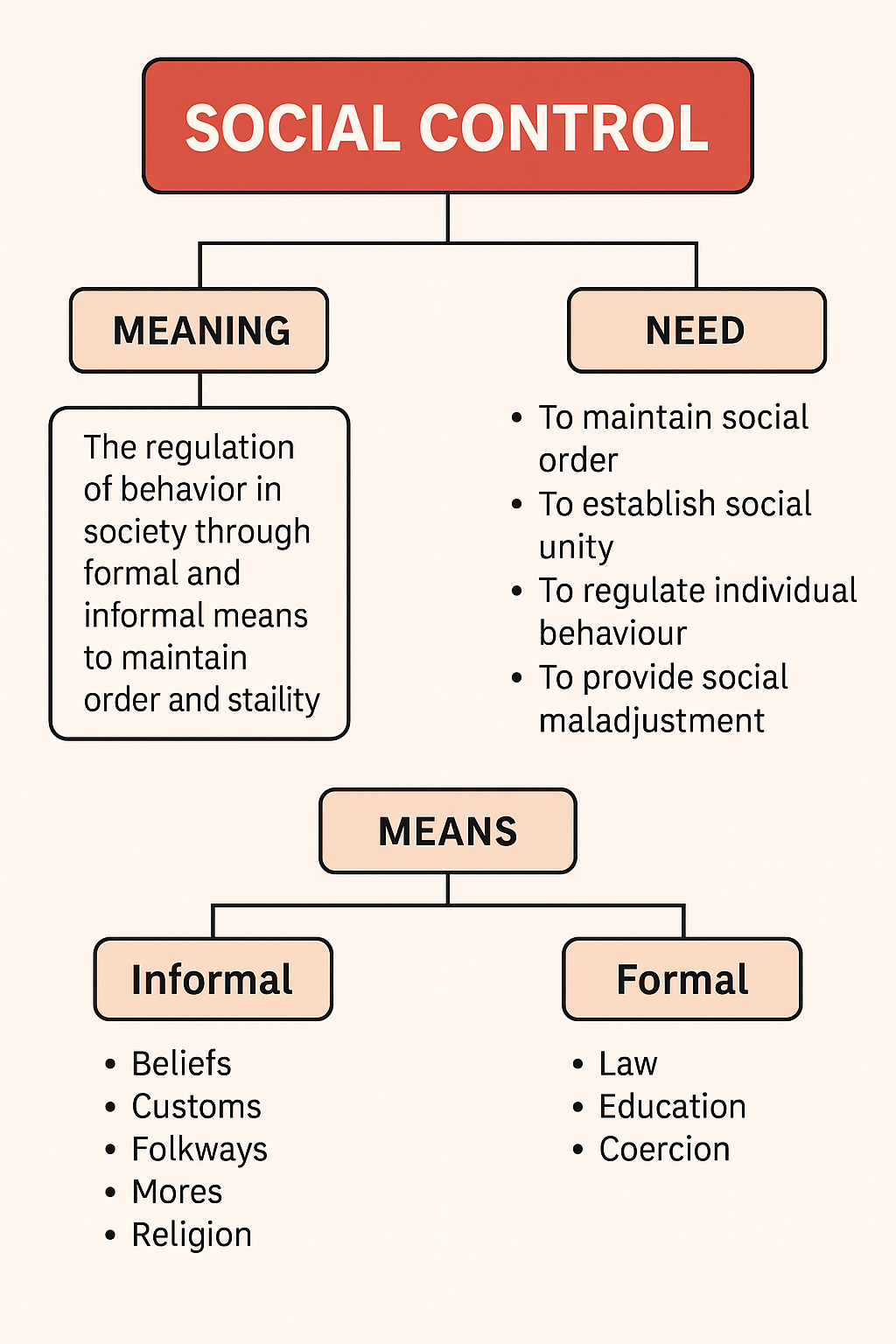
Social control
Meaning of Social Control
- Every society expects its members to behave in a socially approved manner.
To ensure this, society develops various methods, pressures, institutions, and mechanisms to regulate human behavior. - This entire system of influencing or directing individual and group behaviour is known as social control.
- In essence: Social control is the process by which society maintains order, stability, and conformity by controlling individual behavior.
- It keeps people within the cultural limits and protects society from disorder.
Definitions of Social Control
- Mannheim: “Social control is the sum of those methods by which a society tries to influence human behaviour to maintain a given order.”
- MacIver and Page: “Social control is the way in which social order coheres and maintains itself.”
- A. Ross: “Social control is a system of devices whereby society brings its members into conformity with accepted standards of behaviour.”
- General definition: Social control includes all the pressures, techniques, and agencies through which society ensures compliance with norms and values.
Need / Importance of Social Control:
Without social control, society would collapse into chaos. It is essential for the following reasons:
- To Maintain Social Order: Social control prevents disorder and irregular behaviour. It ensures people follow laws, customs, and moral codes. Example: Traffic rules prevent road chaos.
- To Establish Social Unity: Common norms and values unite individuals. Creates harmony in family, community, and society. Example: Greeting elders, respecting teachers.
- To Regulate Individual Behaviour: Humans have different personalities and tendencies. Social control keeps behaviour within socially acceptable boundaries. Example: Laws prevent violence and theft.
- To Provide Social Sanction: Approvals (rewards) encourage good behaviour. Disapprovals (punishments) discourage bad behaviour. Example: Public praise, criticism, guilt, ostracism.
- To Prevent Cultural Maladjustment: When society changes, individuals may adopt harmful habits like: Alcoholism, drug use, gambling, nightlife addictions. Social control protects individuals from such maladjustments.
- To Preserve Cultural Values: Customs, traditions, beliefs, and rituals are preserved through control. Ensures cultural continuity. Example: Celebrating festivals, performing rituals.
- To Ensure Social Progress: A disciplined society is essential for development. Agricultural development, community programs, and extension work require coordinated behaviour.
- For the Survival of Society: Without social control, people would act as they wish, leading to: conflict, violence, lawlessness. Social control is the foundation for peaceful living.
Means of Social Control: Social control operates through two main categories:
- A) Informal Means of Social Control
These are unwritten, traditional, and non-institutional ways of regulating behaviour.
They originate from culture and daily social interaction.
Most effective in rural societies.
- Beliefs
- Belief in God, karma, luck, and supernatural forces.
- Creates fear of punishment and encourages moral behaviour.
- Example: “Good deeds bring good results.”
- Social Suggestions
- Advice given by elders, teachers, and leaders.
- Use stories of great personalities to motivate youth.
- Example: Celebrating Gandhi Jayanti encourages non-violence.
- Ideologies: Systems of ideas shaping behaviour. Examples: Gandhism (non-violence, truth), Communism, Socialism, Capitalism
- Customs: Deeply-rooted practices followed over generations. Control eating habits, marriage, clothing, and greeting styles.
- Folkways
- Everyday habits or customary ways of doing things.
- Breaking them is not seriously punished.
- Examples: Removing shoes before entering home. Offering water to guests. Greeting elders politely
- Mores
- Morally important norms necessary for social welfare.
- Violation leads to strong disapproval.
- Examples: Honesty, Respect for elders, Monogamy, Not harming others
- Norms
- Rules specifying acceptable and unacceptable behaviour.
- Control behaviour by setting expectations.
- Religion
- Powerful source of control through: rituals, sermons, taboos, commandments. Provides moral guidelines.
- Example: Prohibition of eating pork in Islam or beef in Hinduism.
- Art and Literature
- Epics (Ramayana, Bible), folk songs, poems, dramas teach moral values.
- Reinforce ideals of loyalty, courage, honesty.
- Humour and Satire
- Used to highlight wrongdoing.
- Cartoons and satire discourage negative behaviour through ridicule.
- Public Opinion
- Fear of criticism or loss of respect controls behaviour.
- Very strong in villages where everyone knows each other.
- B) Formal Means of Social Control
These are organized, official, and legally enforceable ways of controlling behaviour.
- Law
- Written rules enforced by the state.
- Violation leads to punishment by courts, police, or legal bodies.
- Examples: Traffic laws, Property laws, Marriage and divorce laws
- Education
- Formal schooling teaches discipline, values, cooperation, and citizenship.
- Helps eliminate harmful attitudes and encourages scientific thinking.
- Coercion (Force)
- Physical coercion: Punishments like imprisonment, fines, penalties, or death sentence.
- Non-violent coercion: Strike, Boycott, Non-cooperation, Social pressure Used by communities or organizations to enforce conformity.