Meaning of Social Institutions
- Social institutions are the organized, established systems of social relationships that fulfill the basic needs of society.
- They are created by human beings to maintain stability, order, cooperation, and continuity in social life.
- In simple words: A social institution is a framework of rules, norms, and practices through which society organizes its major activities like family life, education, economy, governance, and religion.
Need for Social Institutions:
- Humans cannot live in isolation. They require:
- Support, cooperation, safety, rules, division of roles, authority, moral guidance
- Social institutions regulate behavior, provide social order, and ensure smooth functioning of society.
Definitions of Social Institutions
- Woodward & Maxwell“An institution is a set of folkways and mores woven together to satisfy several social functions.”
- Horton & Hunt “A social institution is an organized system of social relationships which embodies common values and procedures and meets basic social needs.”
- Ogburn “Institutions are the accepted and established forms of human relationships.”
Characteristics of Social Institutions
- Structured and Organized: Institutions have a clear structure, hierarchy, and rules.
- Social Control Mechanism: They regulate individual behavior through customs, laws, norms, and traditions.
- Stable and Continuous: Institutions last for generations (e.g., family, religion).
- Fulfill Social Needs: Every institution meets a particular social need such as education, parenting, governance, or worship.
- Based on Collective Action: Institutions depend on cooperation and participation of people.
- Guided by Tradition and Customs: Their rules evolve from cultural practices, beliefs, and folkways.
- Have Defined Roles and Statuses: Every member of an institution has expected duties and responsibilities.
Major social institutions in rural society
- Social institutions are the organized and established systems through which society fulfills its basic needs.
- In rural communities, certain institutions play a central role in shaping behavior, organizing relationships, and regulating social and economic activities.
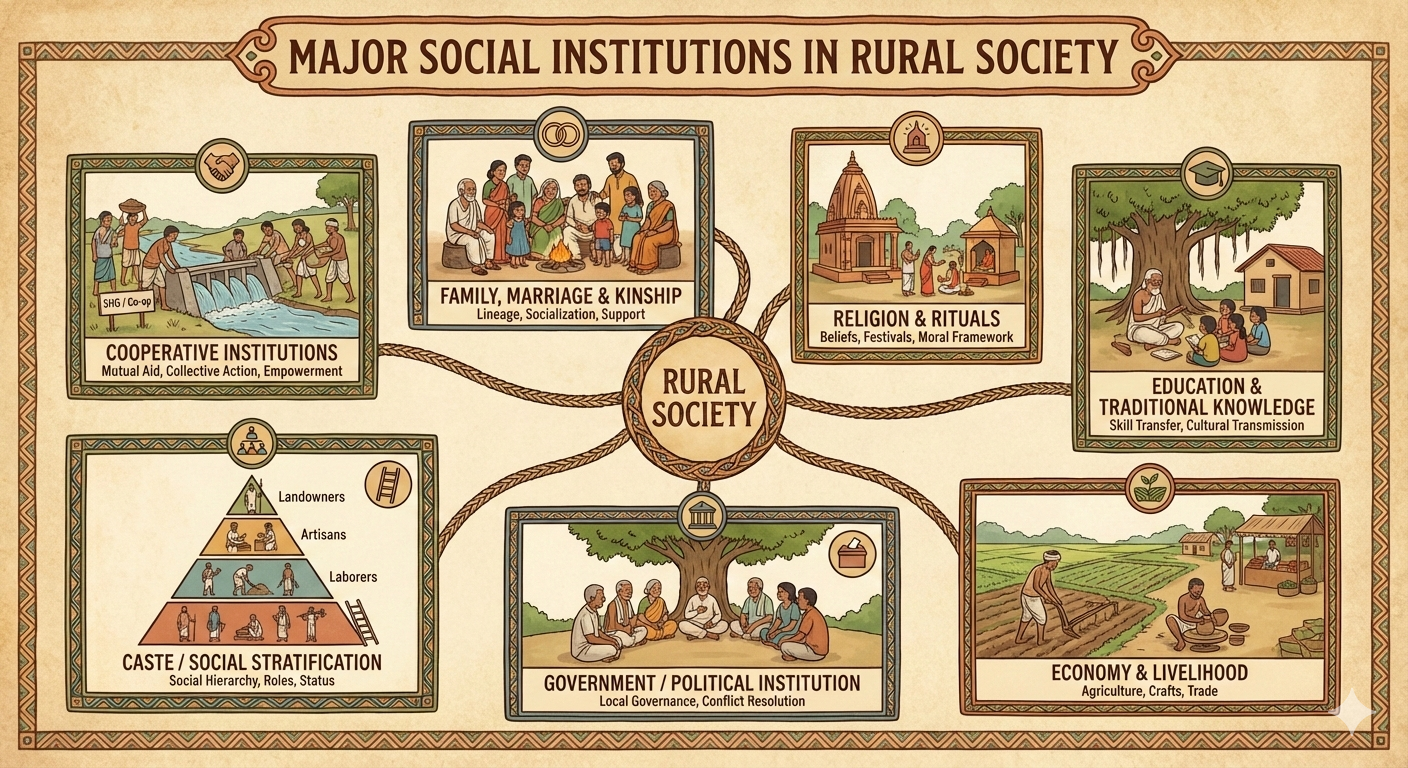
- Here are the major social institutions in rural society,
i) Family
Family is the most fundamental and primary institution of rural society.
Main Features
- Based on blood, marriage, or adoption
- Performs reproduction and child-rearing
- Socializes children into cultural norms
- Provides emotional, economic, and moral support
Why important in rural areas?
- Controls agricultural decisions
- Provides farm labor
- Manages land, livestock, and household resources
- Influences adoption of new agricultural technologies
ii) Marriage: Marriage is the institution that governs family formation and reproduction.
Functions
- Regulates sexual behavior
- Establishes social approval for family life
- Creates kinship connections
- Influences inheritance and property rights
Rural importance
- Strengthens kinship ties
- Determines alliances between families
- Affects land distribution through marriage relations
iii) Religion: Religion is a major institution influencing beliefs, values, rituals, and worldviews.
Functions
- Provides moral and ethical guidelines
- Offers emotional support and security
- Prescribes rituals, festivals, and agricultural rites
- Creates community unity
Rural importance
- Religious leaders are opinion leaders
- Festivals influence farming practices (sowing, harvesting dates)
- Taboos affect livestock and crop choices
iv) Education: Education includes formal schooling (schools, colleges) and informal learning (family, elders, community).
Functions
- Develops knowledge and skills
- Enhances scientific thinking
- Encourages innovation and adoption
- Shapes attitudes and values
Rural importance
- Educated farmers adopt improved technologies faster
- Adult education increases awareness of schemes and markets
- Education improves livelihood opportunities
v) Economy: The economic institution includes systems for the production, distribution, exchange, and consumption of goods.
Components in rural areas
- Agriculture
- Allied sectors (dairy, poultry, fishery)
- Rural industries
- Credit and banking
- Marketing and cooperatives
Importance
- Provides livelihood to majority of rural population
- Determines land ownership and resource distribution
- Influences investment in new technologies
- Drives rural development
vi) Government / political institution: Political institutions include Panchayati Raj, village leaders, administrative bodies, and government departments.
Functions
- Maintain law and order
- Implement development programs
- Resolve conflicts
- Mobilize community participation
- Provide welfare schemes
Rural importance
- Panchayats manage water, roads, schools, irrigation
- Local leaders act as opinion leaders
- Influence adoption of agricultural innovations
vii) Caste / social stratification: Caste is a traditional rural institution determining status, occupation, and social relations.
Functions
- Fixes social status
- Regulates marriage (endogamy)
- Controls division of labor
- Influences leadership and power structure
Rural importance
- Affects group formation and cooperation
- Influences participation in extension programs
- Creates hierarchy in decision-making
viii) Cooperative institutions & shgs (Modern Institutions)
These include:
- Self-Help Groups (SHGs)
- Farmer Producer Organizations (FPOs)
- Dairy cooperatives
- Credit cooperatives
- Marketing cooperatives
Functions
- Provide credit
- Encourage collective marketing
- Empower women
- Promote entrepreneurship
- Support technology adoption
Rural importance
- Improve farmers’ bargaining power
- Reduce dependency on moneylenders
- Strengthen community-based development
Role of Major Social Institutions in Agricultural Extension (In Brief)
- Family
- Influences farmers’ decisions on crop selection, input use, and investment.
- Provides farm labour and manages resources.
- Family attitudes determine acceptance or rejection of new technologies.
- Marriage & Kinship
- Kinship networks spread information quickly.
- Relatives influence adoption decisions and cooperative farming.
- Marriage ties often strengthen group participation.
- Religion
- Religious beliefs, rituals and taboos affect acceptance of certain practices (e.g., piggery, cattle slaughter).
- Religious festivals determine sowing/harvesting timing.
- Religious leaders act as opinion leaders in villages.
- Education
- Educated farmers adopt innovations faster.
- Improves understanding of new technologies, schemes, and markets.
- Increases participation in trainings and demonstrations.
- Economy
- Credit, land ownership, marketing systems influence adoption of new practices.
- Strong economic institutions (banks, cooperatives) support input purchase and technology adoption.
- Government / Panchayati Raj
- Implements agricultural and rural development programs.
- Mobilizes farmers for extension activities (meetings, trainings, field days).
- Local leaders influence adoption decisions.
- Caste / Social Stratification
- Influences group formation, leadership, and participation.
- Affects acceptance of practices and interaction during training.
- Extension workers must work sensitively within caste structure.
- Cooperatives & SHGs
- Promote collective action and group farming.
- Provide credit, inputs, and marketing support.
- Strengthen technology adoption through group-based extension.