Introduction
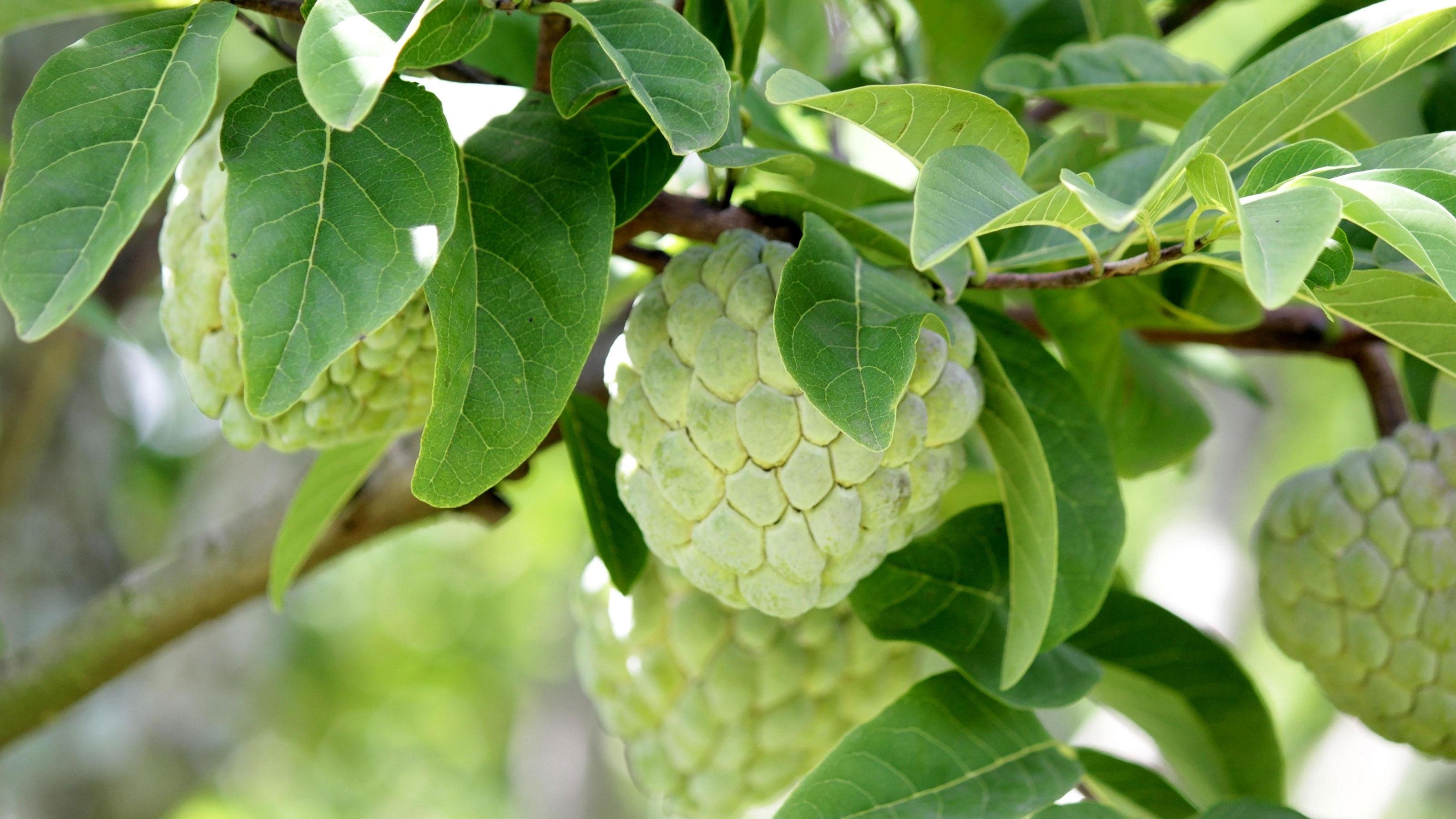
Custard apple, also known as sitaphal or sugar apple, is a popular fruit of the dry region due to its sweet and delicate flesh. It belongs to the Annonaceae family and is a deciduous or semi-deciduous woody shrub reaching a height of 5-6 meters. The fruit is rich in carbohydrates (23.5% sugar), protein (1.6%), calcium (17 mg/100g), phosphorus (47 mg/100g), and iron (1.5 mg/100g).
Key Features of Custard Apple
- Botanical Name: Annona squamosa
- Family: Annonaceae
- Common Names: Sitaphal (India), Sugar Apple (English), Sweetsop
- Origin: West Indies and South America
- Plant Type: Deciduous or semi-deciduous small tree/shrub (5-6 m tall)
- Fruits: Round, heart-shaped, or irregular, covered with knobby scales
- Pulp: Sweet, creamy white, with black seeds
- Nutritional Value (per 100g):
- Carbohydrates: 23.5% (mainly sugar)
- Protein: 1.6%
- Calcium: 17 mg
- Phosphorus: 47 mg
- Iron: 1.5 mg
- Vitamin C: Present in good amounts
Related Species
- Bullock’s Heart / Ramphal (Annona reticulata): Larger, heart-shaped fruits with smooth skin, fewer seeds, but inferior pulp quality.
- Soursop (A. muricata): Fruits with soft spines, highly acidic pulp.
- Cherimoya (A. cherimola): Slightly acidic, sweet fruit with a buttery consistency and fewer seeds.
- Atemoya (A. squamosa × A. cherimola): Hybrid with the superior taste of cherimoya and adaptability of sugar apple.
The fruit is used as a dessert, in ice creams, jams, and jellies.
Climate and Soil Requirements
- Prefers a warm climate with high humidity and mild winters.
- Tolerates extreme temperatures from below freezing to 40°C, but such extremes affect fruiting.
- Thrives from sea level up to 1000 meters.
- Annual rainfall of 500-750 mm is adequate.
- Cherimoya (A. cherimola) prefers cooler climates, while atemoya withstands higher temperatures.
- Can be grown in varied soil types, including rocky, marginal, and waste lands.
- Best yield in well-drained fertile soil with neutral pH.
- Grows in slightly alkaline soil and tolerates mildly saline irrigation water.
Cultivars
- Balanagar: Greenish-yellow fruits (130-140 g), TSS 20.7° Brix.
- Red Sitaphal: Pinkish dark fruits with red pulp (150-160 g), TSS 22.3° Brix.
- Mammoth: Green fruit (125 g), TSS 20° Brix.
- African Pride: Popular cultivar of Atemoya in Australia.
- Pink Mammoth: Juicy pulp with an excellent acidic flavor.
- Arka Sahan: Hybrid (210 g), waxy light green skin, TSS 30° Brix, yield 12 t/ha.
- APK (Ca)-1: Developed in Tamil Nadu, high yielder (14.90 kg/tree), TSS 24.5° Brix.
Propagation and Planting
- Propagated by seeds (germination in 20-30 days), but vegetative propagation (budding/inarching) ensures genetic uniformity.
- Budding: Done in early spring/autumn.
- Inarching: Uses one-year-old scion and rootstock.
- Spacing: 5 m × 5 m.
- Soil treatment at planting:
- 50 g Phosphobacterium + 150 g Vesicular Arbuscular Mycorrhiza (VAM) to improve root growth.
- 10 kg FYM mixed with topsoil.
Nutrient and Water Management
- Manuring:
- 10 kg FYM, 250 g N, 125 g P₂O₅, 250 g K₂O per tree.
- Apply at the start of the rainy season.
- Irrigation:
- Black polythene mulch reduces irrigation needs.
- Annual water requirement: 777.6 liters/tree.
Intercropping Suitable intercrops in young orchards: Groundnut, minor millets, cowpea, linseed.
Special Cultural Operations
- Poor fruit set issue:
- Gibberellic Acid (GA) 50 ppm: Dipping freshly opened flowers ensures better fruit set.
- NAA 20 ppm: Spraying four times at weekly intervals during flowering (March-April) improves fruit retention.
- Mulching and irrigation during summer prevent fruit drop.
Pests and Diseases Management
Pests
Mealybugs (Ferrisia virgata, Maconellicoccus hirstus): Cause blemishes on fruits. Control: Spray 0.05% dichlorvos.
Diseases
- Leaf Spot: Causes premature leaf drop. Management: Fortnightly sprays of 0.05% carbendazim.
- Anthracnose (Glomerella cingulata): Blossom-end infection leads to shriveling. Management: Spray Indofil M-45 (0.02%) at 15-day intervals.
Harvest and Storage
Harvesting Indicators
- Light green fruit color.
- Yellowish-white color between carpels.
- Initial cracking between carpels.
- Peak harvest: October – November.
- Yield: 80-100 fruits/tree after 4-5 years.
Storage Conditions
- Ripening period: A few days after harvest.
- Cold storage: 15-20°C, RH 85-90%, 10% CO₂.
- Storage life: 12-18 days under ideal conditions.
- Prolonging pulp storage:
- Saccharified starch (1:1), high-voltage treatment, nitrogen gas cover, sugar (1:2).
- Shelf life: 45 days at 4°C, 90 days at -18°C.
Yield of Custard Apple (Annona squamosa)
- Per Tree Yield:
- Young Tree (5–10 years): 10–20 kg/tree
- Mature Tree (10+ years): 20–50 kg/tree
- Per Hectare Yield:
- Normal Conditions: 8–10 tons/ha