Course Content
Unit 1 –
Agriculture significantly contributes to the national economy. Key principles of crop production focus on efficient soil, water, and nutrient management. The cultivation practices of rice, wheat, chickpea, pigeon-pea, sugarcane, groundnut, tomato, and mango are vital. Understanding major Indian soils, the role of NPK, and identifying their deficiency symptoms are essential for crop health. Fundamental biological concepts like cell structure, mitosis, meiosis, Mendelian genetics, photosynthesis, respiration, and transpiration are crucial for crop science. Biomolecules such as carbohydrates, proteins, nucleic acids, enzymes, and vitamins play significant roles in plant metabolism. Effective management of major pests and diseases in rice, wheat, cotton, chickpea, and sugarcane is critical. Rural development programmes and the organizational setup for agricultural research, education, and extension support agricultural growth. Basic statistical tools, including measures of central tendency, dispersion, regression, correlation, probability, and sampling, aid in agricultural data analysis.
0/22
Unit 2
The theory of consumer behavior explains decision-making based on preferences and budget constraints. The theory of demand focuses on the relationship between price and quantity demanded, while elasticity of demand measures demand responsiveness to price changes. Indifference curve analysis shows combinations of goods yielding equal satisfaction, and the theory of the firm examines profit-maximizing production decisions. Cost curves represent production costs, and the theory of supply explores the relationship between price and quantity supplied. Price determination arises from supply and demand interactions, and market classification includes types like perfect competition and monopoly. Macroeconomics studies the economy as a whole, while money and banking analyze monetary systems and financial institutions. National income measures a country's total economic output, and agricultural marketing includes the role, practice, and institutions involved in distribution, along with crop insurance, credit, and cooperatives. Capital formation, agrarian reforms, globalization, and WTO impact Indian agriculture by influencing credit access, investments, and global trade policies.
0/21
Unit 3
Farm management involves principles of farm planning, budgeting, and understanding farming systems. Agricultural production economics focuses on factor-product relationships, marginal costs, and revenues. Agricultural finance includes time value of money, credit classifications, and repayment plans. Credit analysis incorporates the 4R’s, 5C’s, and 7P’s, with a history of agricultural financing in India, led by commercial banks and regional rural banks. Higher financing agencies like RBI, NABARD, and World Bank play key roles in credit access, capital formation, and agrarian reforms in India.
0/19
Unit 4
Extension education focuses on the principles, scope, and importance of agricultural extension programs. It includes planning, evaluation, and models of organizing extension services, with a historical development in the USA, Japan, and India. Rural development addresses key issues and programs from pre-independence to present times. It involves understanding rural sociology, social change, and leadership, while promoting educational psychology and personality development in agricultural extension. The Indian rural system emphasizes community values, structure, and adult education.
0/14
Unit 5
Communication involves principles, concepts, processes, elements, and barriers in teaching methods, with various communication methods and media, including AV aids. Media mix and campaigns, along with cyber extension tools like internet, cybercafés, Kisan Call Centers, and teleconferencing, play a key role. Agriculture journalism focuses on the diffusion and adoption of innovations through adopter categories. Capacity building of extension personnel and farmers is essential, with training for farmers, women, and rural youth. Effective communication and extension methods are crucial for agricultural development.
0/13
Topic Wise Multiple-Choice Questions (MCQs)
0/1
Practice Set for JRF
JRF Social Science (ICAR) Indian Council of Agricultural Research

  • Nucleic Acids

Structure:

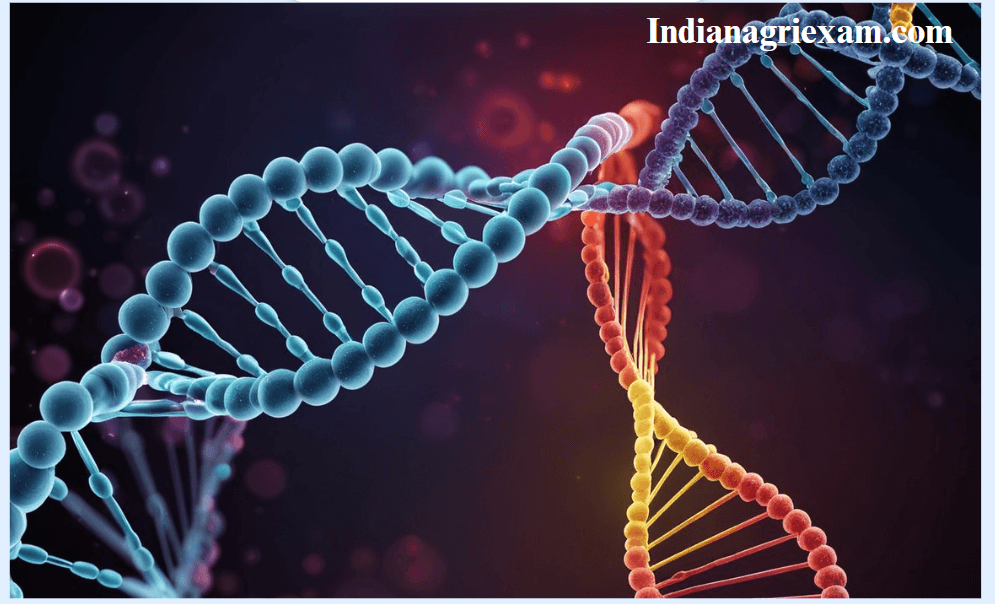
  • Nucleic acids are large macromolecules composed of nucleotides.
    • A nucleotide consists of:
      1. A phosphate group
      2. A pentose sugar (deoxyribose in DNA and ribose in RNA)
      3. A nitrogenous base (Adenine [A], Thymine [T] for DNA, Uracil [U] for RNA, Cytosine [C], and Guanine [G])
  • There are two main types of nucleic acids:
  1. DNA (Deoxyribonucleic acid): Double-stranded helix structure, with a sugar-phosphate backbone and nitrogenous base pairs (A-T, C-G) held together by hydrogen bonds.
  2. RNA (Ribonucleic acid): Single-stranded, with a ribose sugar and uracil replacing thymine (A-U, C-G).


Functions:

  • DNA:
    • Genetic Information Storage: DNA stores genetic information used for the growth, development, functioning, and reproduction of organisms.
    • Replication: DNA replication ensures that genetic material is passed on during cell division.
    • Protein Synthesis: DNA contains the instructions for building proteins through transcription and translation.


  • RNA:
    • Messenger RNA (mRNA): Carries genetic information from DNA to the ribosome for protein synthesis.
    • Transfer RNA (tRNA): Brings amino acids to the ribosome during protein synthesis.
    • Ribosomal RNA (rRNA): Forms the structural and catalytic core of the ribosome, facilitating protein synthesis.


  1. Enzymes

Structure:

  • Enzymes are biological catalysts that speed up chemical reactions without being consumed in the process.
    • Primary Structure: Sequence of amino acids forming a polypeptide chain.
    • Secondary Structure: The folding of the polypeptide chain into alpha-helices and beta-pleated sheets.
    • Tertiary Structure: The three-dimensional shape of the enzyme, essential for its function, with the active site where the substrate binds.
    • Quaternary Structure: Some enzymes are made up of multiple polypeptide chains (subunits).


Functions:

  • Catalysis of Biochemical Reactions: Enzymes lower the activation energy required for a reaction to occur, speeding up metabolic processes.
  • Specificity: Enzymes are highly specific for their substrates, meaning they only catalyze particular reactions.
  • Regulation: Enzyme activity can be regulated by various factors such as temperature, pH, and the presence of inhibitors or activators.
  • Types of Enzymes:
    • Hydrolases: Catalyze hydrolysis reactions (e.g., digestive enzymes like amylase).
    • Oxidoreductases: Catalyze oxidation-reduction reactions (e.g., dehydrogenases).
    • Transferases: Transfer functional groups between molecules (e.g., kinases).
    • Ligases: Join two molecules (e.g., DNA ligase).


Examples:

  • Amylase: Breaks down starch into sugars.
  • Lipase: Breaks down lipids (fats) into fatty acids and glycerol.
  • DNA Polymerase: Involved in DNA replication, catalyzing the addition of nucleotides to form DNA strands.


  1. Vitamins

Structure:

  • Vitamins are organic compounds required in small amounts for normal metabolism and are classified into two groups based on their solubility:
    1. Water-Soluble Vitamins: Vitamin C (ascorbic acid) and the B-complex vitamins (B1, B2, B3, B6, B12, folic acid, biotin, pantothenic acid).
    2. Fat-Soluble Vitamins: Vitamin A, D, E, and K.


Functions:

  • Vitamin A:
    • Function: Essential for vision, immune system function, skin health, and growth.
    • Deficiency: Can lead to night blindness and dry skin.


  • Vitamin B Complex:
    • Function: Each B vitamin has a specific role, including energy metabolism (B1, B2, B3), red blood cell production (B12, folate), and nervous system function (B6).
    • Deficiency: Can cause conditions like beriberi (B1 deficiency), pellagra (B3 deficiency), or anemia (B12 or folate deficiency).


  • Vitamin C (Ascorbic Acid):
    • Function: An antioxidant that helps in collagen formation, wound healing, and iron absorption.
    • Deficiency: Can lead to scurvy, with symptoms such as gum bleeding and weakness.


  • Vitamin D:
    • Function: Promotes calcium absorption in the intestines, essential for bone health.
    • Deficiency: Leads to rickets (in children) or osteomalacia (in adults).


  • Vitamin E:
    • Function: Acts as an antioxidant, protecting cells from damage by free radicals.
    • Deficiency: Rare but can cause nerve and muscle damage.


  • Vitamin K:
    • Function: Essential for blood clotting and bone health.
    • Deficiency: Can cause excessive bleeding or bruising.

 

error: Content is protected !!