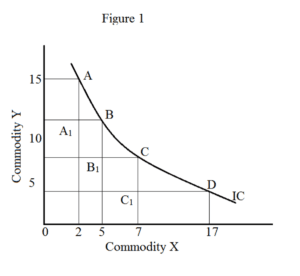
Indifference Curve Analysis:
Indifference Curve Analysis is a core concept in microeconomics, especially for understanding consumer behavior and preference.
1. Indifference Curve Definition
- Definition: An indifference curve represents all the combinations of two goods that give the consumer the same level of satisfaction or utility.
- Key Point: The consumer is indifferent between any two points on the same curve.
2. Properties of Indifference Curves
-
Downward Sloping: As you move down the curve, the quantity of one good decreases as the other increases, but total satisfaction remains constant.
-
Convex to the Origin: The curve is bowed inward, indicating the principle of diminishing marginal rate of substitution (MRS). The consumer is willing to give up fewer and fewer units of one good as they have more of it.
-
Non-Intersecting: Two indifference curves cannot intersect because this would imply inconsistent preferences.
-
Higher Curves Represent Higher Utility: A curve farther from the origin represents a higher level of satisfaction.
3. Marginal Rate of Substitution (MRS)
- Definition: The MRS is the rate at which a consumer is willing to give up one good for another while keeping utility constant. It is the slope of the indifference curve.
- Formula: MRS=ΔY/Δ
- Where ΔY and are the changes in quantities of goods Y and X, respectively.
- Diminishing MRS: As a consumer consumes more of good X, they are willing to give up fewer units of good Y for more units of X.
4. Indifference Map
- An indifference map is a collection of indifference curves, each representing a different level of utility.
- Key Point: The further the curve from the origin, the higher the utility.
5. Budget Line
-
Definition: A budget line shows all possible combinations of two goods that a consumer can purchase given their income and the prices of the goods.
6. Consumer Equilibrium
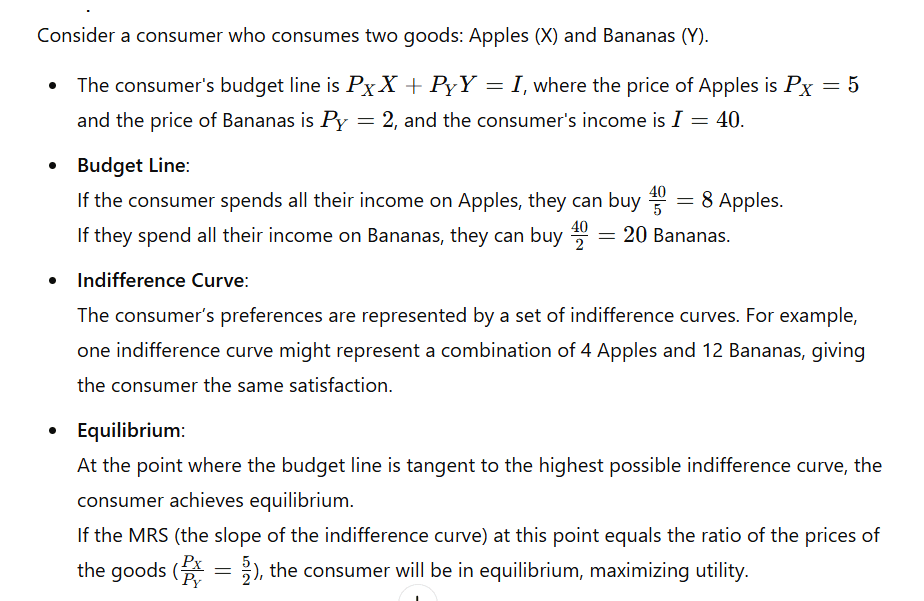
- Condition: Consumer equilibrium is achieved when the budget line is tangent to an indifference curve.
- Key Formula: MRS=PX
- This means the consumer allocates their income so that the marginal utility per dollar spent on each good is equal.
- Indifference Curves and Utility: Remember that indifference curves represent equal levels of utility. More distant curves correspond to higher utility levels.
- Convexity and Substitution: Be clear about the convexity of indifference curves, as it signifies diminishing MRS.
- Consumer Equilibrium: The condition for consumer equilibrium is when the MRS equals the price ratio of the two goods.