Extension Programme Planning
Definition of Extension Programme: According to Kelsey and Hearne (1967), an extension programme is a statement of situation, objective, problem, and solutions.
- Situation: A statement of affairs that includes the cultural, social, economic, and physical conditions in which a particular group of people finds themselves at a given period of time.
- Aim: Aims are generalized and broad statements of direction with respect to given activities. Example: Improving the economic condition of farmers.
- Key Points: Aim includes several objectives. Goal is a part of the objective.
- Objective: Objectives express the ends towards which efforts are directed. Example: Increasing crop yield by 20%.
- Levels of Objectives
- Fundamental or all-inclusive – People’s participation in planning at the grassroots level.
- General objective – More defined social objectives (e.g., mandatory creation of Panchayati Raj bodies in the state).
- Working or specific objective – Example: Enacting suitable laws related to Panchayats, holding timely elections, and providing funds and facilities to Panchayati Raj bodies.
- Levels of Objectives
- Goal: A goal is the distance expected to be covered in a given direction within a specific time frame. Example: Raising the crop yield by 5 quintals per hectare in the current year.
- Planning: Planning is the process of studying the past and present to forecast the future and determining the goals to be achieved and the actions required to reach them.
- Problem: A problem is a condition that people decide needs change after proper study, with or without external help.
- Types of Problems
- Simple Problem – Few and easily identifiable causes.
- Complex Problem – Interrelated causes that are many and difficult to identify.
- Types of Problems
- Solution: A course of proposed action to change an unsatisfactory condition into a more satisfactory one.
- Project: A specification of work to be done or procedures to be followed to accomplish a particular objective.
- Plan: A pre-determined course of action, including mental forecasting for future problems that might arise. It acts as a blueprint for action.
- Plan of Work: An outline of activities arranged efficiently to execute the programme effectively.
- Components of a Plan of Work
- What is to be done?
- Where is it to be done?
- Who is to do it?
- Whom will it serve?
- Why is it needed?
- How will it be implemented and evaluated?
- Components of a Plan of Work
- Calendar of Work: A plan of activities to be undertaken in a particular time sequence.
- Evaluation: The term evaluation originates from the Latin word ‘Valere’, meaning “to be strong or valiant.” It involves measuring performance against pre-determined goals.
- Phases of Evaluation
- Formative Evaluation – Conducted in the early phase of a programme, addressing implementation and planning issues.
- Summative Evaluation – Conducted at the end of a programme to assess its outcomes or impact.
- Types of Evaluation
- Self-Evaluation – Carried out by every worker as a routine practice.
- Internal Evaluation – Conducted by the agency responsible for planning and implementation.
- External Evaluation – Conducted by an external committee or person.
- Concurrent Evaluation – Ongoing evaluation during the execution of a programme.
- Ex-Post Evaluation – Conducted after the programme is completed.
- Types of Evaluation (According to Mishra)
- Planning Evaluation – Consists of two phases:
- Training Need Assessment (Includes Performance Analysis, Task Analysis, Competency Study, and Training Need Survey)
- Instructional Method Assessment
- Process Evaluation/Formative Evaluation – Conducted during programme implementation to solve emerging issues.
- Terminal Evaluation – Conducted at the end of the programme to assess the extent to which objectives and benefits were achieved.
- Impact Evaluation – Evaluates the programme’s impact on participants’ job performance.
- Phases of Evaluation
Principles of Extension Programme Planning
Extension programme planning is a systematic process of identifying needs, setting objectives, organizing resources, implementing activities, and evaluating results to bring desired change among people.
- Analysis of Past, Present, and Future: Study of past experiences, present situation, and future needs of people. Helps avoid repetition of mistakes and ensures relevance.
- Clear and Significant Objectives: Objectives should be specific, realistic, measurable, and need-based. Must reflect people’s real problems. Also known as backbone of planning
- Prioritization of Resources and Time: Selection of activities based on urgency, importance, and feasibility. Ensures efficient use of limited resources.
- Availability and Utilization of Resources: Identification of human, physical, financial, and institutional resources. Proper utilization avoids wastage.
- General Agreement at Various Levels: Consensus among extension personnel, administrators, and beneficiaries. Ensures smooth implementation and support.
- People’s Participation: Active involvement of people at local level. Increases acceptability, sustainability, and success of programmes. Exam Clue: Participation leads to ownership
- Collaboration with Institutions: Coordination with research institutions, NGOs, line departments, and universities. Avoids duplication and improves effectiveness.
- Clearly Defined Plan of Work: Written plan specifying: What to do, How to do, When to do, Who will do, Acts as a working guide.
- Evaluation and Reconsideration: Continuous evaluation of progress and results. Feedback used for modification and improvement. Note: Planning is a continuous process
- Equitable Distribution of Benefits: Benefits should reach all sections of society, especially weaker groups. Prevents inequality and social bias.
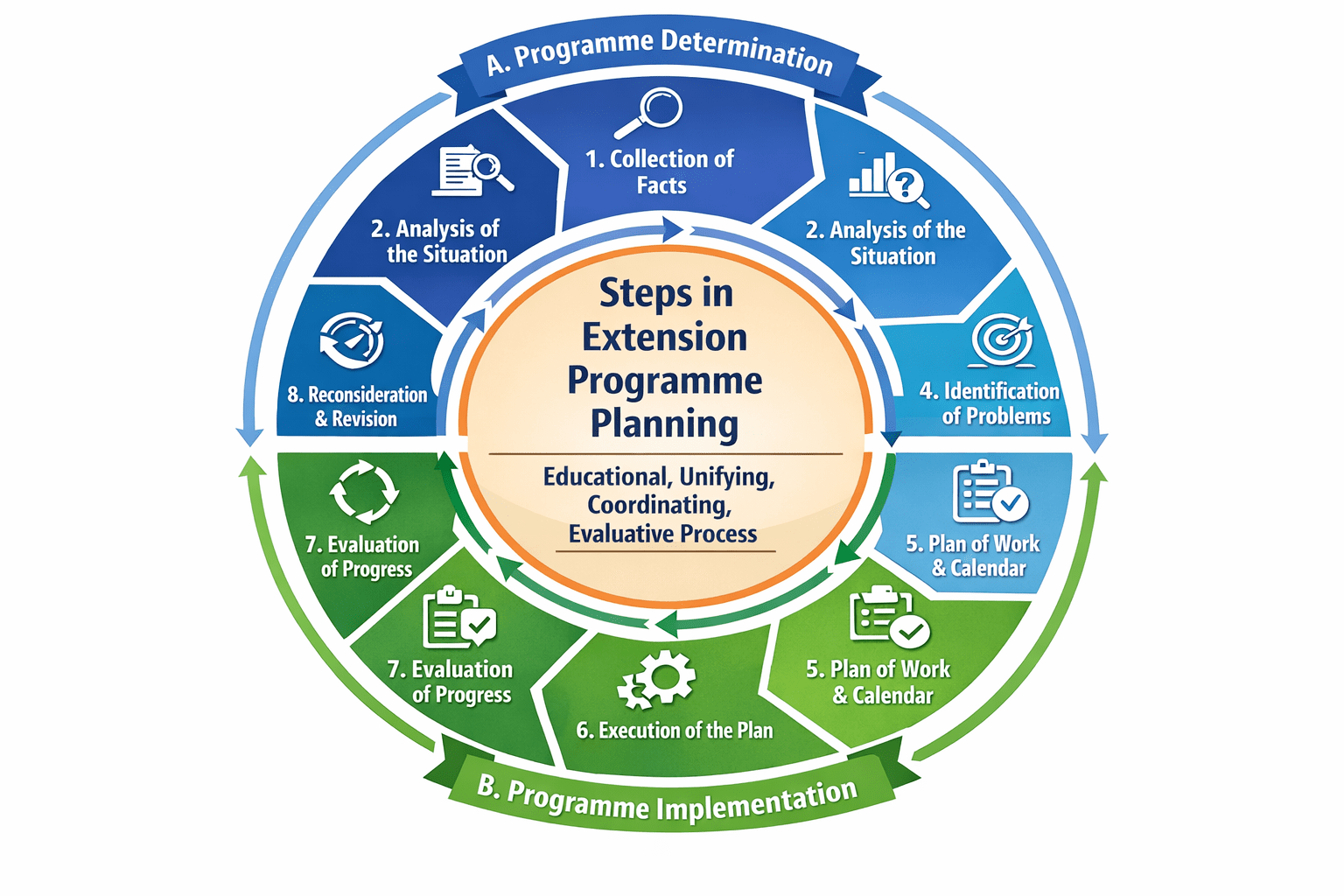
- Steps in Extension Programme Planning
- Extension programme planning is a systematic, logical, and continuous process through which extension activities are planned, implemented, evaluated, and revised to solve people’s problems and bring desirable behavioral change.
Two Phases and Eight Steps
A) Programme Determination / Programme Planning Phase
- i) Collection of Facts
This is the foundation of planning. Reliable information is collected regarding:
- Physical resources (land, water, crops, livestock)
- Human resources (skills, education, leadership)
- Socio-economic conditions
- Cultural practices and traditions
- Existing problems and opportunities
- Methods include surveys, group meetings, PRA, records, and observations.
ii) Analysis of the Situation
Collected facts are organized, interpreted, and analyzed to understand:
- Present status of farming and rural life
- Gaps between existing and desired conditions
- Strengths and limitations of the community
- This step helps in realistic planning.
iii) Identification of Problems
Based on situation analysis, real and priority problems are identified.
Problems are selected considering:
- Seriousness of the problem
- Number of people affected
- Urgency
- Possibility of solution through extension efforts
- Only educationally solvable problems are selected.
iv) Determination of Objectives and Goals
Problems are converted into clear, specific, and measurable objectives.
Objectives describe:
- Expected change in knowledge, skill, attitude, or practice
- Time frame for achievement
- This step provides direction and focus to the programme.
B) Programme Implementation Phase
v) Development of Plan of Work and Calendar of Operations
- A written plan is prepared that includes:
- Activities to be undertaken
- Methods and techniques to be used
- Responsibilities of extension staff and people
- Required resources
- Time schedule (calendar of operations)
- It acts as a blueprint for action.
vi) Execution of the Plan of Work
- This step involves actual implementation of planned activities.
Success depends on:
- People’s participation
- Proper coordination
- Effective communication
- Efficient use of resources
- Flexibility is maintained to handle field realities.
vii) Evaluation of Progress
- Evaluation determines how far objectives have been achieved.
It involves:
- Setting standards or criteria
- Collecting relevant information
- Comparing results with objectives
- Drawing conclusions
- Evaluation helps in identifying strengths, weaknesses, and impact.
viii) Reconsideration and Revision
Based on evaluation findings:
- Objectives may be modified
- Activities may be improved
- New problems may be included
- This step makes programme planning a continuous and dynamic process.
Nature of the Extension Programme Planning Process
- Educational Process: Focuses on learning and behavioral change. Emphasizes self-help and capacity building
- Unifying and Integrating Process: Integrates people’s needs, resources, and extension efforts Brings stakeholders together for common objectives
- Coordinating Process: Coordinates work of: Extension agencies, Research institutions, Line departments, Local organizations, Prevents duplication of efforts.
- Evaluation Process: Evaluation is done at every stage, Ensures continuous improvement and relevance
Need – Concept by Leagans (1961)
Leagans (1961), known as the Father of Extension Education, defined people’s need as the gap between “what is” and “what ought to be.”
This gap indicates the deficiency or problem that requires extension intervention for improvement in individual or community life.
Exam Clue: Need = Present condition − Desired condition
Types of Needs
- Felt Need: Needs that people themselves realize and express. Directly observable through demands and requests. Example: Farmers demanding quality seeds.
- Unfelt Need: Needs that exist but are not recognized by people. Identified by extension workers or experts. Example: Micronutrient deficiency in soil unknown to farmers.
- Perceived Need: Needs identified based on the number of people seeking help or services. Indicates demand through service utilization. Example: More farmers visiting soil testing labs.
- Normative Need: Needs determined by comparing current conditions with fixed standards or norms. Standards are set by experts or institutions. Example: Recommended fertilizer dose vs actual application.
- Relative Need: Needs identified by comparing services or facilities between different communities. Highlights inequality or imbalance. Example: One village having irrigation facilities while another does not.
Importance in Extension Education
- Helps in problem identification
- Guides programme planning
- Ensures need-based extension interventions
- Improves effectiveness of development programmes
One-Line Revision
- Leagans defined need as the gap between “what is” and “what ought to be.”
- Felt need = expressed by people
- Unfelt need = recognized by experts
- Normative need = based on standards
- Relative need = comparison between communities