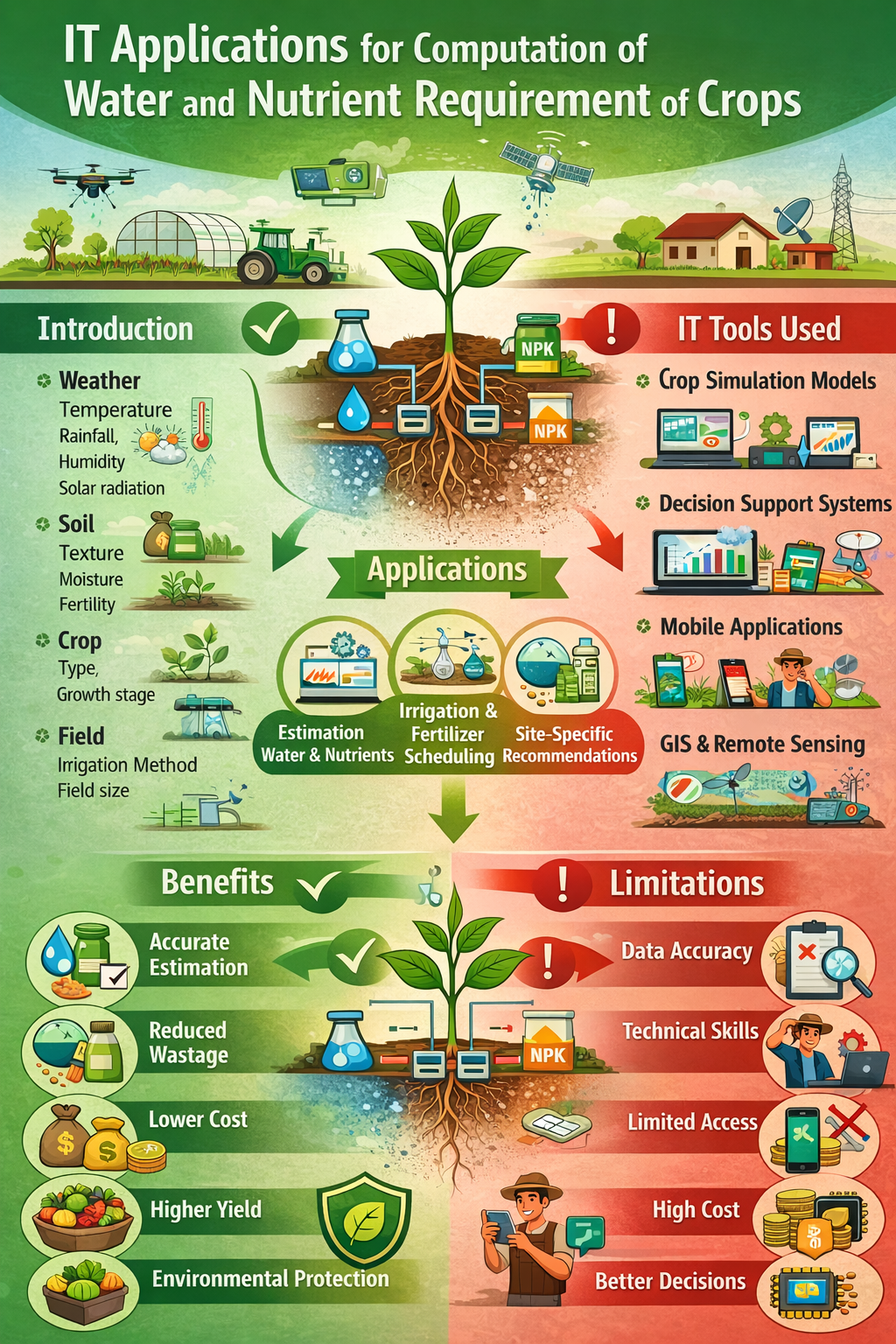
IT Applications for Computation of Water and Nutrient Requirement of Crops
Introduction
- Efficient management of water and nutrients is critical for achieving higher crop productivity, reducing input costs, and ensuring sustainable agriculture. Information Technology (IT) plays a vital role in computing the exact requirement of irrigation water and nutrients for crops by integrating data related to soil, crop, weather, and management practices.
- IT-based tools help farmers and planners make scientific, data-driven decisions instead of relying on traditional guesswork.
IT Applications for Computation of Water Requirement: IT applications calculate crop water requirement based on: Crop type and growth stage, Soil characteristics, Weather parameters, Irrigation method. The goal is to supply optimum water at the right time and quantity.
a) Data Used for Water Requirement Computation: Accurate computation of crop water requirement depends on the integration of multiple datasets:
Weather Data
- Includes temperature, rainfall, relative humidity, wind speed, and solar radiation.
- These parameters influence evapotranspiration (ET), which determines how much water a crop loses to the atmosphere.
- IT systems use real-time and forecast weather data to adjust irrigation schedules.
Soil Data
- Soil texture (sand, silt, clay) determines infiltration and drainage.
- Water-holding capacity indicates how much water soil can retain for plant use.
- Soil moisture status helps assess when irrigation is needed.
- Digital soil databases improve precision in irrigation planning.
Crop Data
- Crop coefficient (Kc) varies with crop type and growth stage.
- Growth stage (initial, vegetative, flowering, maturity) determines water demand.
- IT tools use crop-specific data to compute stage-wise water requirement.
Field Data
- Irrigation method (flood, drip, sprinkler) affects water application efficiency.
- Field size and layout influence total irrigation volume.
- Field-level inputs help customize recommendations for individual farms.
b) IT Tools Used for Water Requirement Computation
Various IT-based tools are used to process the above data and generate accurate recommendations:
Crop Simulation Models
- Simulate crop growth and water use under different climatic conditions.
- Predict water demand throughout the crop season.
- Useful for long-term planning and research.
Decision Support Systems (DSS)
- Integrate soil, crop, and weather data.
- Provide irrigation scheduling advice (timing and quantity).
- Help farmers and planners make informed decisions.
Mobile Applications
- Deliver irrigation advisories directly to farmers.
- Easy to use and accessible in rural areas.
- Provide real-time, location-specific recommendations.
GIS and Remote Sensing
- Used for spatial analysis of crop water stress.
- Satellite images detect moisture stress and variability across fields.
- Useful for regional-level water management and planning.
IoT-Based Soil Moisture Sensors
- Measure soil moisture in real time.
- Enable automatic or sensor-based irrigation systems.
- Improve precision and reduce water wastage.
c) Applications of IT in Water Requirement Computation
- Estimation of Crop Evapotranspiration (ETc): IT tools calculate ETc using weather and crop data. Helps determine the actual water requirement of crops.
- Irrigation Scheduling: Advises when to irrigate and how much water to apply. Prevents over-irrigation and under-irrigation.
- Water-Use Efficiency Assessment: Evaluates how effectively water is used by crops. Supports adoption of efficient irrigation methods like drip irrigation.
- Drought Stress Monitoring: Early detection of water stress using remote sensing and sensors. Helps take timely corrective measures to reduce yield loss.
- Precision Irrigation Planning: Site-specific irrigation based on field variability. Reduces water wastage and improves crop productivity.
- Overall, these IT applications support water conservation, higher irrigation efficiency, and sustainable agricultural production.
IT Applications for Computation of Nutrient Requirement
IT applications compute crop nutrient requirements by scientifically analyzing:
- Soil nutrient status (available N, P, K and micronutrients)
- Crop nutrient demand at different growth stages
- Target yield expected by the farmer
- Fertilizer efficiency and method of application This approach ensures balanced, precise, and site-specific nutrient management, avoiding under- or over-fertilization.
a) Data Used for Nutrient Requirement Computation
Accurate nutrient computation depends on the integration of the following data:
- Soil Test Values: Available macronutrients (N, P, K). Micronutrients (Zn, Fe, Mn, Cu, B, etc.). Soil pH and organic carbon. These values indicate nutrient deficiencies or excesses.
- Crop Nutrient Uptake Data: Nutrient requirement per unit yield of a crop. Varies with crop type and growth stage. Helps estimate total nutrient demand.
- Yield Targets: Expected or desired crop yield. Higher yield targets require higher nutrient supply. Used in target yield–based fertilizer recommendations.
- Fertilizer Type and Nutrient Content: Nutrient percentage in fertilizers (e.g., urea, DAP, MOP). Determines the exact quantity of fertilizer needed.
b) IT Tools Used for Nutrient Requirement Computation
- Soil Test–Based Nutrient Recommendation Software: Generates fertilizer recommendations based on soil test results. Promotes balanced fertilization.
- Decision Support Systems (DSS): Integrate soil, crop, and yield data. Provide nutrient management advisories to farmers and planners.
- Digital Soil Health Card Systems: Store soil fertility data digitally. Provide crop-wise fertilizer recommendations. Improve accessibility and transparency.
- Mobile Applications: Deliver fertilizer advisories directly to farmers. User-friendly and location-specific. Useful for small and marginal farmers.
- GIS-Based Nutrient Mapping: Maps spatial variability of soil nutrients. Helps identify nutrient-deficient zones. Supports regional-level nutrient planning.
- Precision Agriculture Tools: Variable-rate fertilizer application. Sensor-based nutrient monitoring. Reduces wastage and input costs.
c) Applications of IT in Nutrient Requirement Computation
- Calculation of Fertilizer Dose (NPK): Computes exact fertilizer quantities required per hectare.
- Site-Specific Nutrient Recommendation: Tailors nutrient application to individual fields.
- Identification of Nutrient Deficiencies and Excesses: Early detection helps prevent yield loss and toxicity.
- Improving Nutrient Use Efficiency (NUE): Ensures maximum crop uptake with minimum losses.
- Reducing Nutrient Losses and Environmental Pollution: Minimizes leaching, runoff, and greenhouse gas emissions.
- Overall, IT supports cost-effective, efficient, and environmentally safe fertilizer management.
d) Integration of IT for Water and Nutrient Management
Modern IT systems integrate water and nutrient requirement computation for holistic crop management.
Major Integrated Applications
- Precision Farming Site-specific water and fertilizer application.
- Fertigation Management Combined application of water and nutrients through irrigation systems.
- Climate-Smart Agriculture Adjusts inputs based on climate variability.
- Sustainable Crop Production Optimizes resource use and protects the environment.
e) Components of Integrated IT Systems
- Weather Forecasting Predicts rainfall and temperature for input planning.
- Soil and Crop Databases Store historical and real-time information.
- Real-Time Sensor Data Soil moisture and nutrient sensors for precision management.
- Advisory Platforms Deliver timely recommendations to farmers.
Benefits of IT Applications
- Accurate Estimation of Water and Nutrient Needs IT tools integrate soil, crop, and weather data to calculate precise water and fertilizer requirements, reducing guesswork.
- Reduced Wastage of Inputs Site-specific and need-based recommendations minimize excess use of water and fertilizers, preventing losses through leaching and runoff.
- Lower Cost of Cultivation Optimized input use reduces expenditure on irrigation, fertilizers, and labour, improving farm profitability.
- Increased Crop Yield and Quality Timely and balanced supply of water and nutrients enhances crop growth, productivity, and produce quality.
- Environmental Protection Reduced nutrient losses and efficient water use help prevent soil degradation, water pollution, and greenhouse gas emissions.
- Improved Farmer Decision-Making Real-time advisories and data-driven recommendations support better planning and management decisions.
Limitations of IT Applications
- Dependence on Accurate Data Input Incorrect or incomplete soil, weather, or crop data can lead to inaccurate recommendations.
- Need for Technical Knowledge Farmers and extension workers require training to effectively use IT tools and interpret results.
- Limited Access to IT Infrastructure in Rural Areas Poor internet connectivity and lack of digital devices restrict adoption in many regions.
- Initial Cost of Technology Investment in sensors, software, and hardware can be expensive, especially for small and marginal farmers.